Friday, May 12, 2017

Students as creators and dynamic evaluators


As educators, we all agree that we want students to be creators - placing them in open-ended contexts where they have to apply their knowledge (and content) to solve problems.


And, we all agree that have students take an active role in evaluating quality is beneficial to learning. Evaluating quality most likely consists of:
  • self-assessments,
  • peer-assessments, or
  • having student help determine quality by establishing rubrics prior to beginning.


Here’s how these elements usually play out in the classroom:
  1. An authentic PBL problem/project is shared.
  2. Students learn and apply content as they create solutions, sharing their product.
  3. Teachers provide time for students to self-assess or peer-assess. Learning, and potential for future improvement, is facilitated.


The more dynamic we can make this feedback cycle, the greater potential for learning.


Basketball players can watch film of previous games (to self or peer evaluate).  Certainly, while playing the game, players also learns skills which can be practiced for future development. In this sense, basketball players mimic a strong classroom experience.


However, basketball players (or jazz musicians or a Socratic discussion participants) have to do more. Certainly they must take action (problem-solve); but they also must evaluate and adjust along the way.  When one player gets hot and is making every shot, the other 9 players on the court all adjust.


These are the experiences where creativity and evaluation are happening simultaneously. There is an interdependence between participants that is typically missing from most classroom experiences. The thinking and actions of one participant can quickly affect others. The act of evaluating is not an after-the-fact (wonderful) add-on to aide learning; it is a necessity to successfully navigating a dynamic experience!


Can we shorten (or even integrate!) the action and feedback cycle in our classrooms within authentic, open-ended problems? The more we can, the more we mirror the type of learning that.students will need in their future and has proven effective in many real life learning experiences.


The Power of Games-Based Learning


Here is where the power of Games-Based Learning (GBL) has huge potential. Consider the recent success of Minecraft and other multi-player simulations. Students are certainly creating their own solutions within these environments. It’s easy to see how students learn from this interaction - picking up ideas and techniques from others. But students are also interacting and evaluating within an environment that is changed by their action.


The real beauty of these environments? Just like our basketball game, they are dynamic based upon the actions of the participants.  This better represents the real world problem-solving (and real-world learning along the way) - where there are seldom “right” and “wrong” answers. Instead, participants must navigate messy environments that more closely resemble gray rather than black and white.
Creating GBL environments where learners must:
  • Analyze relevant variables, seeking to make meaning with models, patterns, and generalizations
  • Form conclusions
  • Take reasonable actions


Our best GBL learning environments allow many opportunities where each of these 3 stages can be reasonably debated by intelligent participants. Content and skills are needed, but they are not the goal. They are means to an end - successful application in a specific context as judged by peers. This is the power of GBL. Multiple choice and essay assessments can’t compete. If we want GBL to take root in more classrooms we need to leverage their unique potential to provide this interactive model.


Our Solution… and Challenges Ahead


We are two educators at the core.


We founded our company with the belief that learning in schools must to be naturally engaging and mirror the skills of the real-world to promote intrinsic student motivation. That belief has guided us in creating a learning experience with five unique features needed to prepare our students for tomorrow.


1) Students who move beyond recall and produce solutions with content.
2) Social Learning: Learning from and with one another.
3) Contextual Learning: Authentic roles & goals
4) Students as creators and dynamic evaluators.
5) Empower instructors to guide meaningful learning experiences.


At simCEO, we believe we have a model that addresses this challenge, and highlights how GBL can change learning by offering students engaging real-life experiences.


The simple premise allows students to create companies to form an online stock market. Within this environment, each student has two roles with a distinct goal.
  1. Create and manage a successful company by ending with a high share price.
  2. Maximizing an investment portfolio of $10,000 within this market by identifying how dynamic news will affect various companies.


As news is shared, the environment changes. And, like Minecraft, as students take actions (adjusting their company’s business plan or buying/selling shares), the simulation itself (company’s strategies and share prices) dynamically changes.

Because the environment is dynamic and inter-dependent, we have students who are simultaneously creating/adjusting solutions while also evaluating (and learning from) others' solutions.


The challenge we need to overcome?
Building (and using) this sort of open-ended GBL environments is different. We see two main challenges we have to overcome.


  1. Typical games are plug-n-play experiences with scripted storylines.  Open-ended GBL experiences require changes in expectations and focus on different skill-sets. If users expect a plug-n-play, they will be disappointed - just as they would with Minecraft.
    • Teachers can - and should be - shapers of learning.  SimCEO (like Minecraft) require teacher customization to better target traditional curricular outcomes.
    • Students need to learn to be creators and simultaneous evaluators of quality. They are not just seeking the fastest way through a quest. They are not short-cut seekers, looking to outsmart the programming to win by gaming-the-game.


  1. Open-ended learning environments are likely aimed at different goals than traditional, linear GBL environments. This can sometimes confuse. In traditional GBL environments, the user’s growth is visible and directly related the product - usually the ‘level’ of attainment. But in open-ended GBL environments, the goal of the game may not be the main learning goal. Creating and running a successful business (or building a cool Minecraft environment) is informative, but doesn’t fully represent the student’s learning. There's no guarantee that the 'winner' of such a game actually learned more or even established the best business. Small formative assessments can be built in to assess traditional content - similar to linear gbl environments. But to really tap into the power of open-ended, dynamic environments, we need to ask deeper questions to students?.
    • Why did you _____ ?
    • Why did you choose the action of X when presented with Y?
    • What action within this environment represents your best decision? Why?
    • What skills or content do you need to better understand in order to improve?
It will take creative solutions to leverage the real power of these open-ended GBL environments. It’s a journey - one that our students need us to take. That’s why we seek partners who share our passion.


Innovative teachers: We invite you to customize an environment in our simulation for your students.

Advocates of innovative GBL: We are actively seeking partners with experience in investment, business development, or B2B partnerships who can take this model of learning to the next level for a new generation of students.

(This is the 4th article in a series of 5.)

Wednesday, May 3, 2017

Contextual Learning: Authentic Roles & Goals


Article 3 in a series of 5

At simCEO, we are educators at the core.


We founded our company with the belief that learning in schools must to be naturally engaging and mirror the skills of the real-world to promote intrinsic student motivation. That belief has guided us in creating a learning experience with five unique features. Learning - for tomorrow - must address these elements.


1) Students who move beyond recall and produce solutions with content.
2) Social Learning: Learning from and with one another.
3) Contextual Learning: Authentic roles & goals
4) Students as creators and dynamic evaluators
5) Empower instructors to guide meaningful learning experiences.


In this post, we explore part 3 of 5: the role of contextual learning. What does the research say? How have we attempted to contextualize learning? And, what problems still exist?


We know research validates the positive learning effects of constructivism. But let’s unpack constructivism using this helpful definition:


Constructivism as a paradigm or worldview posits that learning is an active, constructive process. The learner is an information constructor. People actively construct or create their own subjective representations of objective reality. New information is linked to prior knowledge.


The folks at TeachingHacks nicely break down constructivism into two main areas:


  • Cognitive constructivism ...knowledge as being created through experience. Knowledge is not transferred from teacher to student in a ready-made format, but actively built by each learner. …


  • Social constructivism looks at learning from a social perspective… As students engage in discussion and social interaction they construct their knowledge by considering other peoples’ opinions and actions. Educators have the opportunity to eavesdrop on ideas that are going back and forth between students, give feedback and guide student understanding.


So, we know students need to construct their own knowledge. We know that activities such as spelling lists of 20 random words are ineffective. How do we provide experiences which contextualize the content? How can we provide environments which foster students constructing their own knowledge and understandings?


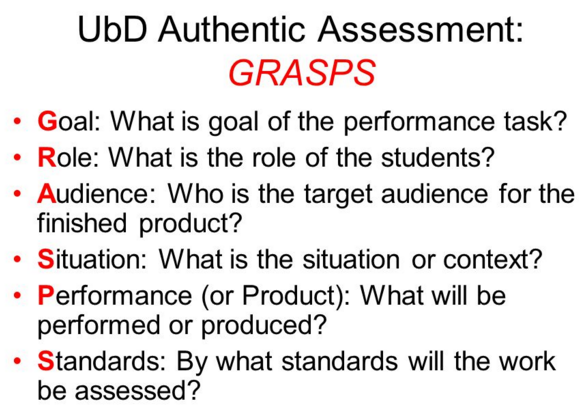
One of the more effective tools to help educators design these experiences - often known as Authentic Assessments - comes from Grant Wiggins’ GRASP model.


GRASPS is defined in more detail here, Wiggins himself provides many concrete examples of what these experiences look like at various subjects and grade levels. At simCEO, we focus on creating these experiences.
Constructivism and Games-Based Learning


These authentic learning experiences allow students to construct knowledge. Project-Based Learning (PBL) advocates have championed this model for years. It’s a model that has struggled to find it’s footing in Games-Based Learning (GBL).


Early games bring to mind flash cards. Later developments focus on quests that may or may not be authentically connected to the desired outcome (travel through space to return home by answering math questions not connected to the quest). The recent introduction of multi-player games -and the great success of games such as MineCraft - highlight the potential GBL has  in tapping into the social constructivism within open-ended environments where there are multiple pathways to the same goal. At the core of making the experience authentic and real world,  we need to give students an explicit role with a specific goal. But these roles need to allow for students to take their own direction and make their own choices. Students must be given the space to construct their own knowledge as they learn from - and with - others. That doesn’t happen often enough in classrooms, and it happens even less in GBL.  That’s both the beauty (and potential) of GBL, and highlights the main challenge that lies ahead.


Games like Minecraft are not directly related to most traditional school curriculum. They often require educator-customization to target traditional outcomes. (The importance of traditional outcomes such as math, history, etc. compared to 21st Century Skills is a separate question, worthy of separate exploration.)  If we are to assume that traditional school subjects will continue to be driving force in our learning, then open-ended GBL experiences which foster creativity and problem solving will need to balance, support, and align with traditional subject outcomes in order to facilitate adoption. It’s a challenge to develop these GBL experiences without making them sequential quests with right/wrong answers; To fully harness social constructivism, students need to  interact with the each other (not a computer program) to learn and problem solve.


We’re navigating the tip of the iceberg. We have lots to uncover.


At simCEO, we believe we have a model that addresses this challenge, and highlights how GBL can change learning.


Using the GRASP model, here’s where we believe we’ve succeeded… and where we still have work ahead of us.


GRASPS
simCEO
Goal
Two goals: 1) to end with the highest company share price, and 2) to end with the highest investment portfolio value
Role
Students have 2 authentic roles within their classroom stock market: 1) as a CEO, to create and manage a company that ends with the highest share price, and 2) as an investor who can maximize a starting $10,000 investment portfolio.
Audience
As students create and manage their company, their audience is their fellow students - who will play a role in evaluating them in their dual role as investors in the stock market. It a less-connected context, the “audience” for the students’ work can also be the parents and community, if the simulation is shared with others.
Situation
Students each asked to create and manage a company within an instructor-defined context (eg. Boston 1776 or NYC, current day)  for a fictional 10-year period. These companies form an interactive classroom stock market. Additionally, students will review each other's’ companies and are asked to maximize their initial $10,000 investment portfolio.wisely as they react and apply knowledge to news articles which are introduced.
Performance
Students need to create and manage a viable business plan that will be successful over a fictional 10-year period in the setting chosen by the instructor. Students will also need to make wise investment decisions based on changing conditions during the simulation.
Standards
In an pedagogical sense, simCEO is linked to standards in Economics, Business & Entrepreneurship, and Financial Literacy. These are included. Instructors can also customize elements of the simulation to target more traditional standards, as desired.

In a more practical sense, the standards by which student work will be judged by:

  • ending share price. This indicates that their answers have successfully influenced their peers (and teacher) by effectively communicating a quality solution (business plan).
  • ending investment portfolio value. This indicates that they were able to apply a solid understanding of the impact that various news articles would have on different companies throughout the simulation.


The Challenges Ahead


We continue to seek help from passionate people and organizations who are interested in partnering with us solve our two main challenges.


CHALLENGE #1: Teacher Customization: How much do we desire teachers to be involved in aligning their GBL experience to their curriculum and their students?
One of the unique elements we built into simCEO was teacher customization. Our foundational belief is that instructors know the needs of their students better than any instructional designers or programmers. For example:
  • Should student business plans be limited to one type of company or industry?
  • How complex should the business plan be? What topics should the plans cover?
  • Should simCEO have a specific time, place, and conditions to dictate the simulation?
  • What types of news articles should students encounter during the simulation to encourage them to adjust their business plan or investment strategy?


We’ve tried to balance the following aspects,  providing some default options while opening the door to teacher customization. But with each option we offer for teacher customization, we lose the ability to structure a sequential storyline. This increases the teacher’s responsibility as the experience becomes less of a ‘plug-n-play’ tool. It also makes assessment trickier.


CHALLENGE #2: How much, and what type of, assessment should be built into an open-ended simulation?

Plug-n-play games allow for easier built-in student assessment. Open-ended simulations like MineCraft and simCEO rely more on teachers. To some degree, this is simply a perception shift that needs to happen. Pre-programmed assessments, by their nature, are right/wrong. Once we place students in authentic contexts where they can create their own solutions, we limit the amount of pre-created assessments that are possible. When we allow teachers to customize - broadening the scope of what is possible to meet their learners' needs - we limit the scope of pre-programmed assessments even further. But thankfully, these types of GBL experiences allow for true student reflection within an authentic context. We see how students apply their understanding in action. Their actions, and reflections on those actions, tell us so much more about their level of understanding than any multiple-choice test could.

The cultural shift comes in how we view these open-ended GBL resources. Instead of plug-n-play experiences, we believe these resources should be considered authentic contexts to apply content. Instructors are empowered to shape the specific content and assessment - and can even incorporate their traditional classroom assessments into a new environment.
Instructors who approach these environments as plug-n-play experiences, where students click “go” and are immersed in a simulated environment which measures their ability to choose the correct multiple choice options, will likely be confused by this new type of resource. But as this cultural shift takes hold, we can truly empower instructors to drive assessment.


We remain committed to bringing social constructivism to life in GBL.  These are the problems that need solutions in order to take the next step in games-based learning, integrating our GBL environments into open-ended PBL ones.


We are encouraged by the reality that these problems are best solved by educators themselves (instead of programmers). Our hope is to leverage the collective intelligence and experience of educators and innovators around the world to build these environments for our students.


It's a journey. That's our mission. If it's one that moves you, join in and help us make it a reality.


Jetlag Learning creator and CEO, Derek Luebbe, is the current Head of School at the Shanghai Community International School (SCIS), Pudong Campus


At Jetlag Learning, we create online learning simulations where students compete and interact with one another - instead of a program -  to make the learning environment more dynamic and mirror real-world problem solving.


Friday, April 28, 2017

Social Learning: Learning from and with one another.

At simCEO, we are educators at the core.

We founded our company with the core belief that learning in schools must to be naturally engaging and mirror the skills of the real-world to promote intrinsic student motivation. That belief has guided us in creating a learning experience with five unique features. Learning - for tomorrow - needs to have these elements.


1) Students who move beyond recall and produce solutions with content.
2) Social Learning: Learning from and with one another.
3) Contextual Learning: Authentic roles & goals
4) Students as creators and dynamic evaluators
5) Empowering instructors to customize learning experiences for their students.


Earlier, we shared the ideal elements needed to move from student recall to students who create solutions with content.  It takes an open-ended, real-world, engaging problem with critical thinking and decision-making at it’s core.  

Our post today focuses on social learning.


Those types of learning experiences can no longer exist only between teacher and student. Students need to see - and learn from - how other students try to navigate these experiences. In short, we need to move from the one-to-one teacher:student model to the many-to-many model.


Model
Teacher
Student
One to One
Teacher tutors one. Provides task. Teacher provides feedback, evaluates, and returns work.
Student turns in work. Student receives feedback.
One to Many
Teacher gives lecture. Online tutorials.
Student solves a problem on a blog. Students gives verbal presentation.
Many to Many
Guided/Socratic  discussions. Online chat room. Team sports.
Help forums. Online mult-player games.


What defines quality experiences in the many to many model?  In it’s simplest form, it embodies the essence of Bandura’s social learning - allowing learners to learn in a specific context through imitation and modeling. In it’s best context, there is a blurred line between the expert and learner. Everyone accepts responsibility for both roles.

Our best learning environments allow students to learn from - and with - one another. The teacher’s role is transformed into a context maker who learns what students can do.


As Kathleen Norris from the Center for Digital Education shares in K-12 Classrooms Needs to be Hotbeds of Social Learning, “Social learning is the education strategy of the playground, of the workplace, of the dinner table, of the learning strategies of Plato, Dewey and, more recently, of serious thinkers such as Lev Vygotsky and Seymour Papert. The time has come to support educators in taking advantage of 1-to-1, Internet-connected, Web 3.0 technologies and make our children’s classrooms hotbeds of social learning.”


We created simCEO with this idea in mind. Give students an authentic goal with many possible solutions, and allow them to learn from the diversity of opinions they see. It’s both blessing and a curse.
  • Teachers love the creativity simCEO fosters. Students create their own business to thrive in a specific environment / context. And, they see (and learn) how each other approached those same problems and came up with different solutions. Students make adjustments to their own business which model best solutions for their own context/business.
  • Students see news articles and recognize that changes affect each company differently. They adjust their business plan and their investment philosophy to these changing conditions. Equally important, they see how other students react (differently) to these same news articles.


But we also see evidence of intelligent, committed educators who struggle finding the best way to “tie it all together.”  Open-ended learning can sometimes feel like trying to pin down a cloud. Perhaps this is compounded with online, open-ended learning.
  • How can I effectively assess micro vs. macro entrepreneurial student decisions, and evaluate each accurately? For example, Student A sets up the “right” business for a particular environment but cannot understand or apply supply and demand. Student B has a poor business idea but applies his knowledge of supply and demand beautifully.
  • How can I measure the quality of business plans - or adjustments to those plans - within a dynamic environment?
  • How can I separate (and evaluate) lucky actions and adjustments from competent applications of knowledge?


Open-ended tasks are complex and more than a little messy. They are filled with what if? moments where students make choices and go down various pathways. That doesn’t always lend itself to easy assessments. But those are the real-world environments our students need navigate.


We continue to seek out feedback from educators who have ideas for how to best evaluate within these open-ended environments.


But let’s not forget. Learning experiences with discrete outcomes may be easier to evaluate, but those experiences offer little context for social learning. We can’t aim for “right” at the expense of “meaningful”.


Jetlag Learning creator and CEO, Derek Luebbe, is the current Head of School at the Shanghai Community International School (SCIS), Pudong Campus


At Jetlag Learning, we create online learning simulations where students compete and interact with one another - instead of a program -  to make the learning environment more dynamic and mirror real-world problem solving.

Our first simulation, simcEO,  product targets entrepreneurship and financial literacy as students create their own companies to form an interactive stock market,  and then buy/sell shares in each other's company to influence the share prices as they react to news stories - real or fictional.

Saturday, March 11, 2017

Student Entrepreneurship: Partners Wanted

As a start-up with an innovative idea, at simCEO we’re always looking to expand our reach through partners who can add value and further our mission to reach students.
If you’re excited by real world learning where students each create their own company and those companies combine to form an interactive stock market so that students can practice investing and entrepreneurship in a dynamic environment, then we’d love to connect.
Since winning the SIIA Most Innovative Ed Tech Incubator Award, we know simCEO represents a powerful tool to help transform education.
Specifically, we’re seeking:
    • Purpose-driven individuals and organizations who can add value to our cause through investment, leadership or partnerships to take simCEO to the next level.
    • Educators interested in sharing simCEO with other schools as partner representatives.
    • Local or regional organizations who can help share simCEO with schools – free of charge – to support efficacy research on entrepreneurial and financial literacy skills.
Entrepreneurship and financial literacy are just the beginning! We think big to transform education – and we know we have an innovative model to get there.
    • Moving beyond recall: Students develop business plans and other real products for a real audience.
    • Students as creators, applying content in a specific context.
    • An environment where students as evaluators of (each others) quality.
    • Real world environments: open-ended,  dynamic, and with a specific context.
    • Empowering educators to customize and target learning
We seek passionate partners who can help us scale this type of learning to students around the world.
Follow our story on Twitter @simCEO , and share your story with us. Or, reach out to us at info@simCEO.org .